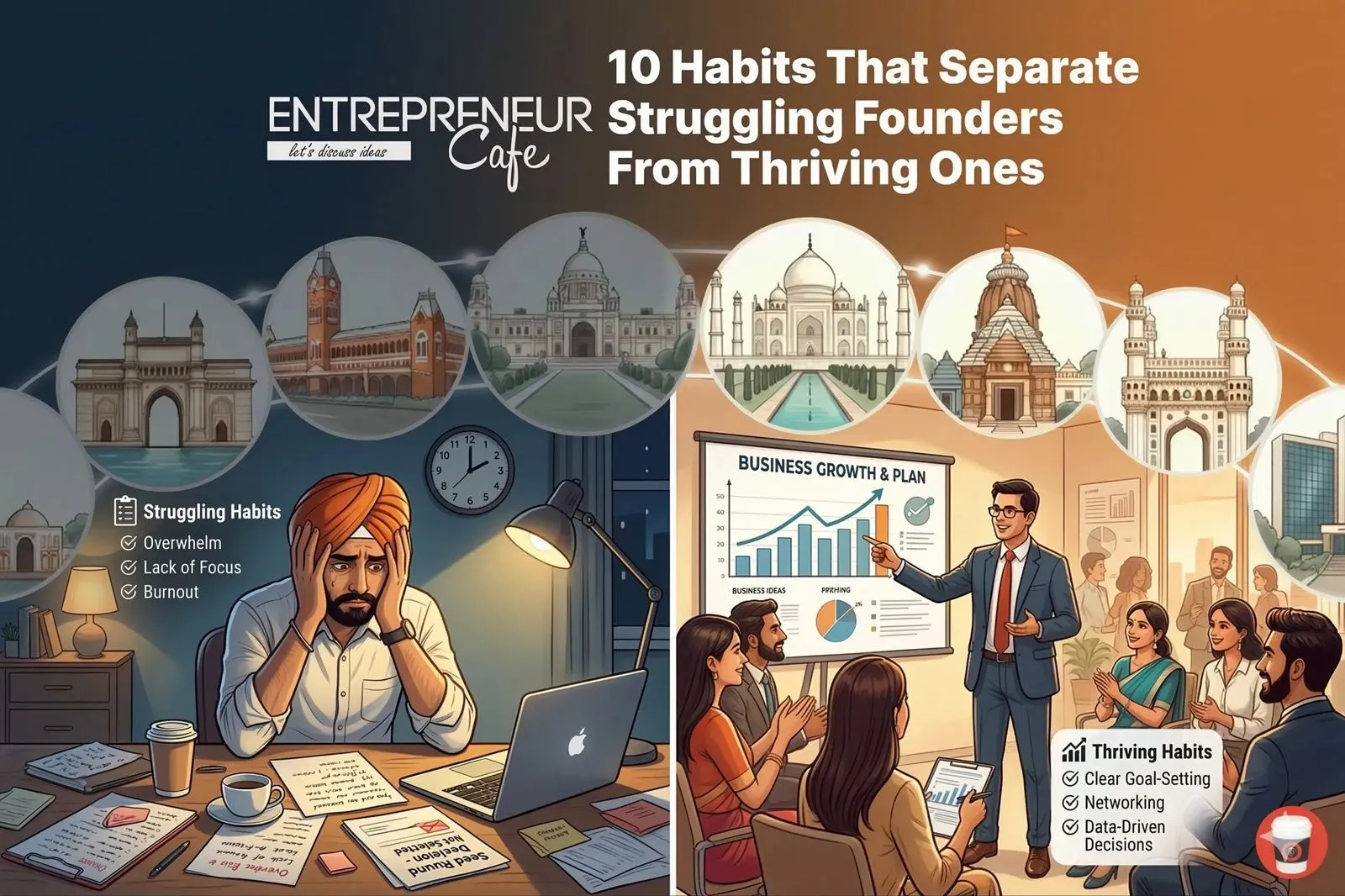
Walk into any room full of founders and you will find two kinds of people. Those who are building with clarity, momentum, and a quiet but unmistakable confidence. And those who are busy, stressed, and perpetually feeling like they are one bad week away from everything falling apart.
The difference between these two founders is rarely the idea. It is rarely the funding. It is rarely even the market. More often than not, it comes down to habits. The small, daily, seemingly unremarkable things that compound over time into either a thriving company or a struggling one.
This is not a list of productivity hacks. This is not about waking up at 5am or taking cold showers. This is about the real, substantive habits that the most successful founders practice consistently — and that the struggling ones almost universally neglect.
Here are the 10 habits that separate founders who thrive from founders who survive.
1. They Know Their Numbers Cold
Thriving founders do not wait for their accountant to tell them how their business is doing. They know their revenue, their burn rate, their runway, their margins, and their customer acquisition cost at any given moment. Not approximately. Precisely.
According to Jessie Hagen of U.S. Bank, 82% of business failures are linked to poor cash flow management. The founders who avoid this fate are the ones who treat financial literacy not as a finance department responsibility but as a core founder skill.
Review your numbers every week. Build a simple dashboard. Know what is moving and what is not. Because you cannot make good decisions about a business you do not fully understand.
2. They Talk To Customers Every Single Week
Struggling founders build in isolation. They get caught up in product decisions, team meetings, and investor updates — and weeks go by without a single real conversation with an actual customer.
Thriving founders protect customer time the way they protect sleep. They know that the market is always changing and the only way to stay calibrated is to stay connected to the people they are building for.
Steve Blank, the father of the Lean Startup movement, built his entire methodology around one simple truth — no business plan survives first contact with customers. Get out of the building. Talk to your customers. Do it every week without exception.
3. They Protect Their Energy, Not Just Their Time
Every founder knows about time management. Very few practice energy management.
Time is fixed — you get 24 hours. But energy is variable. A founder operating at full energy can accomplish in four hours what a depleted founder cannot accomplish in ten. The thriving founders understand this. They protect their sleep. They exercise. They take breaks that are actually breaks. They know that their mental and physical state is the most important input into every decision they make.
Research from the Harvard Business Review found that executives who actively managed their energy — physical, emotional, mental, and spiritual — were significantly more productive and more effective than those who simply tried to manage their time. For founders, this is not a wellness conversation. It is a performance conversation.
4. They Ask For Help Before They Need It
Struggling founders wait until they are in crisis before reaching out. Thriving founders build their support network long before they need it — and they use it consistently.
This means finding mentors early. It means being honest with your board or advisors about what is not working. It means showing up to your community not just when you have something to celebrate but when you are in the middle of something hard.
The founder who asks for help proactively is not weak. They are strategically intelligent. They understand that the collective wisdom of people who have been through what they are going through is one of the most valuable resources available to them — and they do not wait for a crisis to access it.
5. They Say No More Than They Say Yes
Early stage founders are often people pleasers by necessity. They say yes to every meeting, every opportunity, every introduction, every request — because everything feels important and they are terrified of missing something.
Thriving founders learn early that focus is a competitive advantage. Warren Buffett famously said that the difference between successful people and very successful people is that very successful people say no to almost everything. For founders, every yes is a no to something else. Every distraction is a withdrawal from the focus account that your most important work depends on.
Build a filter. Know your priorities. And say no without guilt to everything that does not move your most important needle.
6. They Reflect Before They React
The startup environment is designed to trigger reactive decision making. Things move fast. Problems demand immediate responses. Investors want answers. Customers want solutions. And in that pressure cooker, the instinct is to act immediately.
Thriving founders have developed the habit of creating space between stimulus and response. Not a long space — sometimes just five minutes. But enough to ask — is this actually urgent, or does it just feel urgent? What are the second order consequences of the decision I am about to make? Am I reacting from fear or responding from clarity?
Viktor Frankl wrote that between stimulus and response there is a space, and in that space lies our freedom and our growth. For founders navigating chaos daily, that space is everything.
7. They Invest In Their Own Learning Consistently
The market is always changing. Technology is always evolving. What worked eighteen months ago may be completely irrelevant today. Thriving founders know this — and they treat learning not as something they will get to eventually but as a non-negotiable weekly practice.
This does not mean consuming every podcast and newsletter available. It means deliberate, focused learning that is directly connected to where their business needs to grow. A founder struggling with sales spends time specifically on sales. A founder building in AI makes it their business to understand what is actually happening in that space right now.
According to LinkedIn's Workplace Learning Report, 94% of employees say they would stay at a company longer if it invested in their learning and development. The same principle applies to founders — the ones who keep learning keep growing.
8. They Build In Public
This is a habit that more founders are discovering — and the ones who practice it consistently are building audiences, attracting talent, and creating opportunities that their quieter counterparts simply do not have access to.
Building in public means sharing your journey openly. Not just the wins — the lessons, the pivots, the hard decisions, the things that are not working yet. It means treating your startup story as a resource for others who are on the same path.
Daniel Vassallo and countless other founders have demonstrated that building in public creates a flywheel of community, credibility, and opportunity that no amount of traditional marketing can replicate. It is one of the most underutilised habits in the founder playbook — and one of the most powerful.
9. They Show Up For Their Community
Thriving founders are not just consumers of community. They are contributors. They show up to their entrepreneur networks not just to take — to get introductions, to ask for advice, to access resources — but to give. To share what they know. To make introductions for others. To be the person in the room who asks a fellow founder how things are really going and actually listens to the answer.
This habit of community contribution is not just altruistic. It is strategic. The founders who are known in their communities as generous, reliable, and genuinely supportive are the ones who find that opportunities come to them. Investors want to back them. Talented people want to work for them. Partners want to build with them.
Entrepreneur Cafe was built on exactly this principle — that showing up consistently for a community of fellow entrepreneurs is one of the highest leverage activities a founder can invest their time in. Across 110 cities and 26 countries, the founders who show up every month are the ones building the strongest networks and the most resilient businesses.
10. They Play The Long Game
Perhaps the most important habit of all — and the one that is hardest to maintain in the short term pressure of building a startup.
Thriving founders make decisions with a long time horizon. They hire people who will grow with the company, even when a cheaper short term hire is available. They build customer relationships with genuine care, even when it would be easier to optimise for quick revenue. They invest in their own health, their community, and their learning — even when the immediate returns are not visible.
Struggling founders optimise for next month. Thriving founders optimise for next decade. And over time, that difference in orientation produces entirely different companies — and entirely different founders.
Jeff Bezos built Amazon's entire strategy around what he called long term thinking — making decisions that might look suboptimal in the short term but create compounding advantages over years and decades. You do not have to be building Amazon. But the principle applies at every scale.
The Common Thread
Look across all ten of these habits and you will find a common thread. None of them are dramatic. None of them require a special talent or an extraordinary circumstance. They are all small, consistent, repeatable practices that any founder can start today.
The gap between struggling and thriving is not as wide as it looks from the outside. It is built one habit at a time. One week of consistent customer conversations. One month of showing up for your community. One year of protecting your energy and playing the long game.
Start with one. Build from there. And find a community that holds you accountable to the standard you are trying to meet.
Entrepreneur Cafe is a free, global community where entrepreneurs meet monthly over coffee to share ideas, get feedback, and build real relationships. Present in 110+ cities, 26 countries, and 6 continents. Find your chapter at entrepreneurcafe.org
Sources
- SCORE — Cash Flow Statistics for Small Businesses https://www.score.org/resource/infographic-cash-flow-statistics
- Steve Blank — No Plan Survives First Contact With Customers https://steveblank.com/2010/03/11/no-plan-survives-first-contact-with-customers/
- Harvard Business Review — Manage Your Energy Not Your Time https://hbr.org/2007/10/manage-your-energy-not-your-time
- CNBC — Warren Buffett on Saying No https://www.cnbc.com/2018/10/03/warren-buffett-says-knowing-what-to-avoid-is-the-key-to-success.html
- Viktor Frankl — Man's Search For Meaning https://www.goodreads.com/quotes/9-between-stimulus-and-response-there-is-a-space-in-that
- LinkedIn Workplace Learning Report https://learning.linkedin.com/resources/workplace-learning-report
- Daniel Vassallo — Building In Public https://twitter.com/dvassallo
- Amazon — Jeff Bezos 1997 Shareholder Letter https://www.sec.gov/Archives/edgar/data/1018724/000119312513151836/d511718dex991.htm
- Entrepreneur Cafe — Global Entrepreneur Community https://entrepreneurcafe.org